Effective assessment management is essential to delivering a successful course—and Coursebox gives you the tools to do both with ease.
In this section, you’ll learn how to create and manage assessments that track learner progress, reinforce key concepts, and evaluate understanding. Whether you're setting up quizzes, collecting responses, or reviewing learner performance, Coursebox supports a range of assessment formats that suit different learning goals.
Watch the Tutorial Videos found in our Demonstration Video Library.
Adding Quizzes
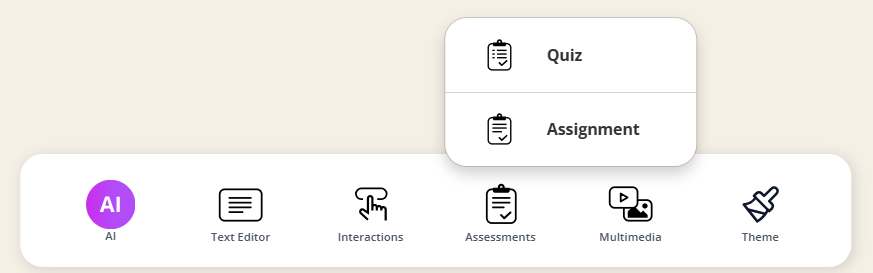
To assess learner understanding and reinforce key concepts, you can add a Quiz to your course. Click Add Item and select Quiz from the dropdown menu.
Quizzes can include various question types and are a great way to check knowledge, provide feedback, and keep learners actively engaged throughout the course.
There are two ways you can generate Quizzes:
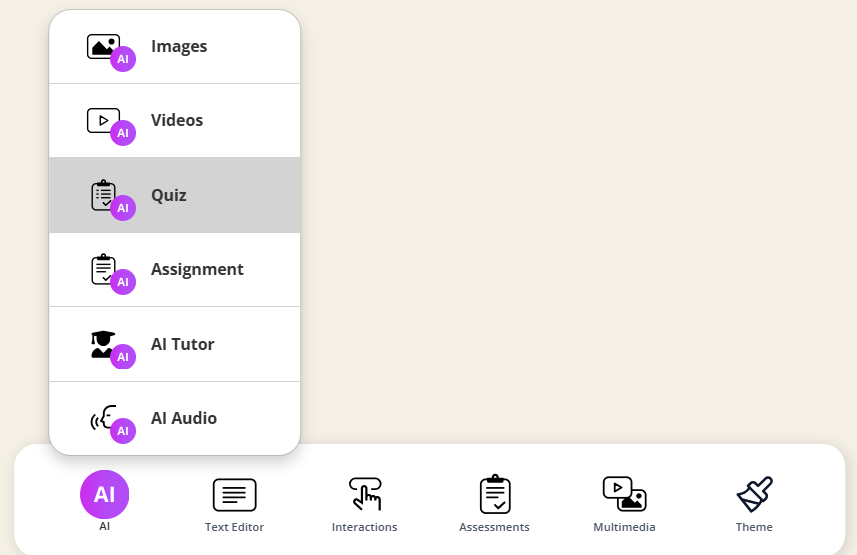
Option 1: Use Ai Quiz
Click the AI Quiz Writer button to create quizzes using AI and in the next screen follow the steps below.
Option 2: Use Quiz from bottom menu
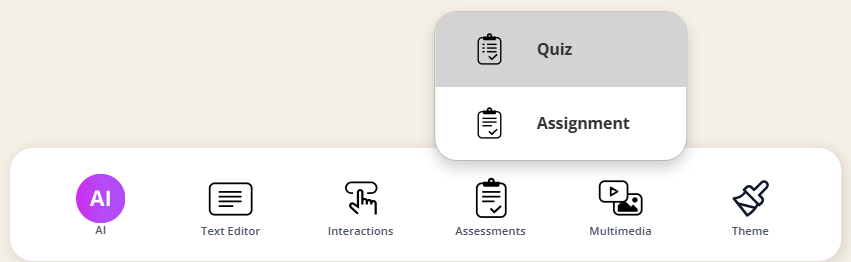
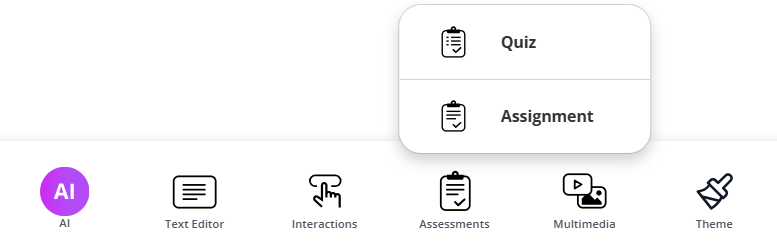
Click on Assessments and select Quiz from the bottom navigation.
Create a Quiz with AI
From either of the steps above, you’ll arrive at this screen.
- Use the slider to choose whether the quiz is generated using the course content.
- Select the number of Quiz Questions and then click Generate Questions.
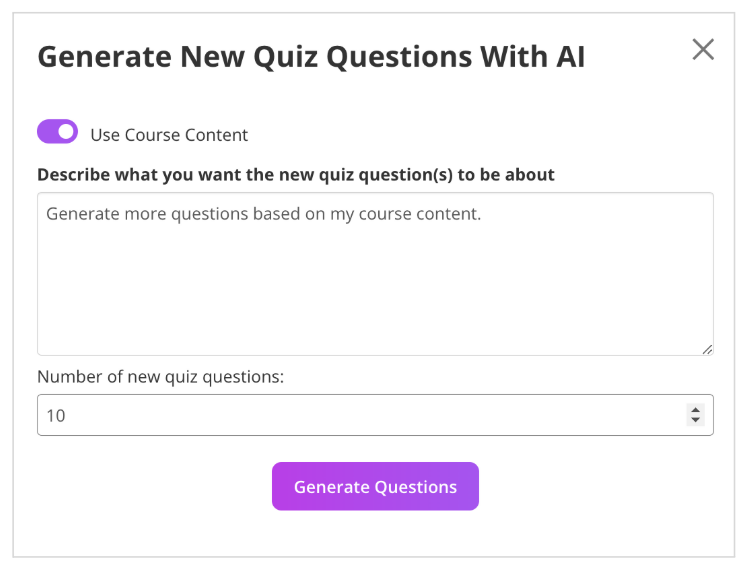
- Or, leave the slider off to generate quiz questions based only on your prompt, without using the course content.
- Select the number of Quiz Questions and then click Generate Questions.
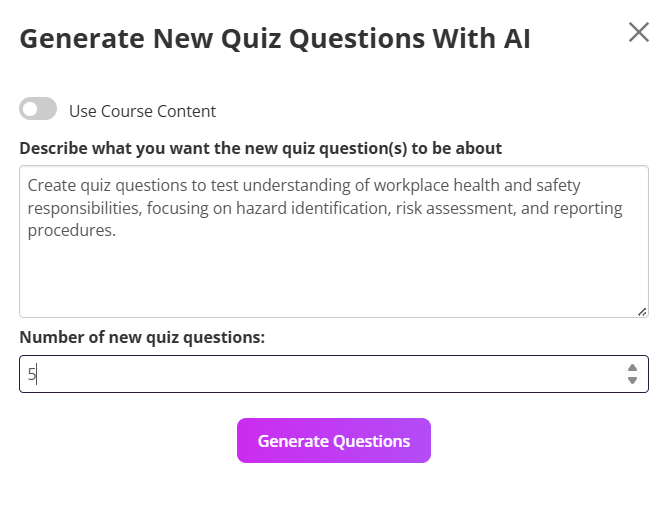
- On the next screen, adjust your desired pass settings.
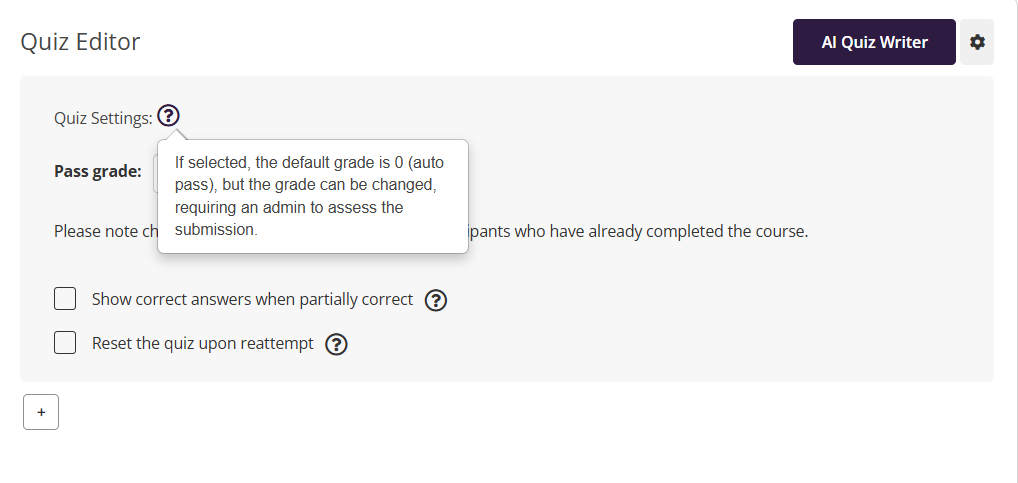
- Enable correct answers.
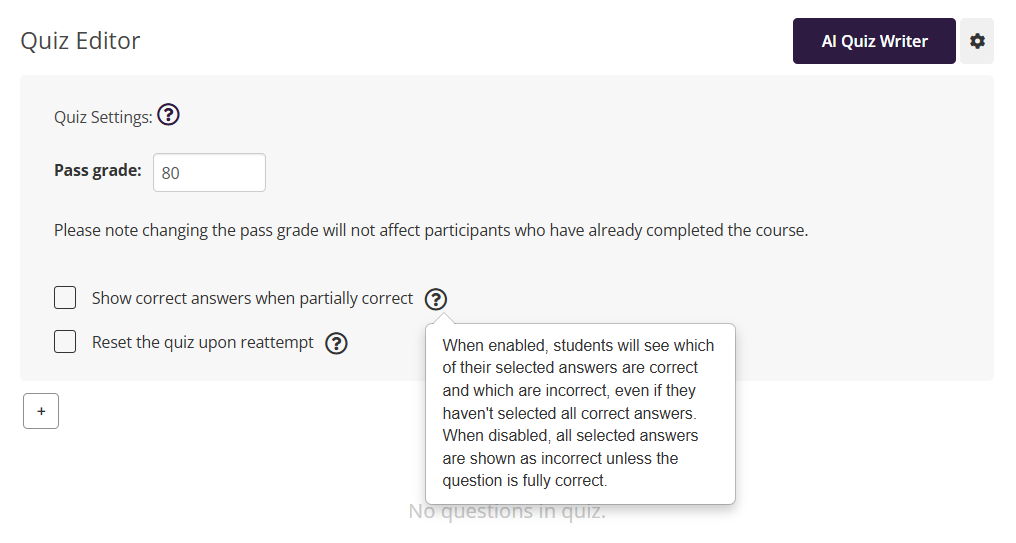
Enable quiz reset.
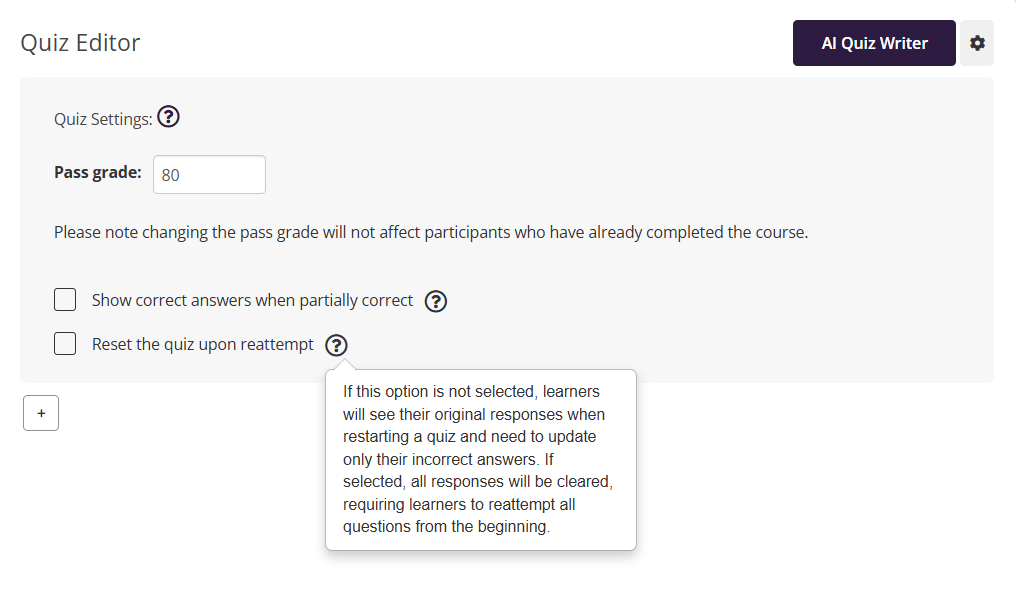
- Set Quiz visibility
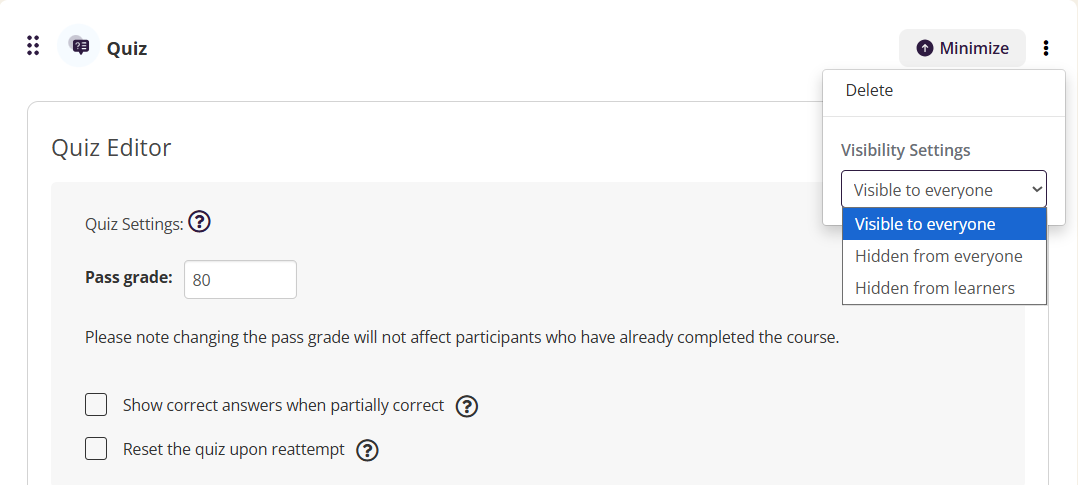
Creating additional Quiz Questions
Once the quiz is added to your course, you can customise by adding additional types of questions.
Cousebox supports four types of questions.
Click the + button to add a new question. Then select from the drop-down menu.
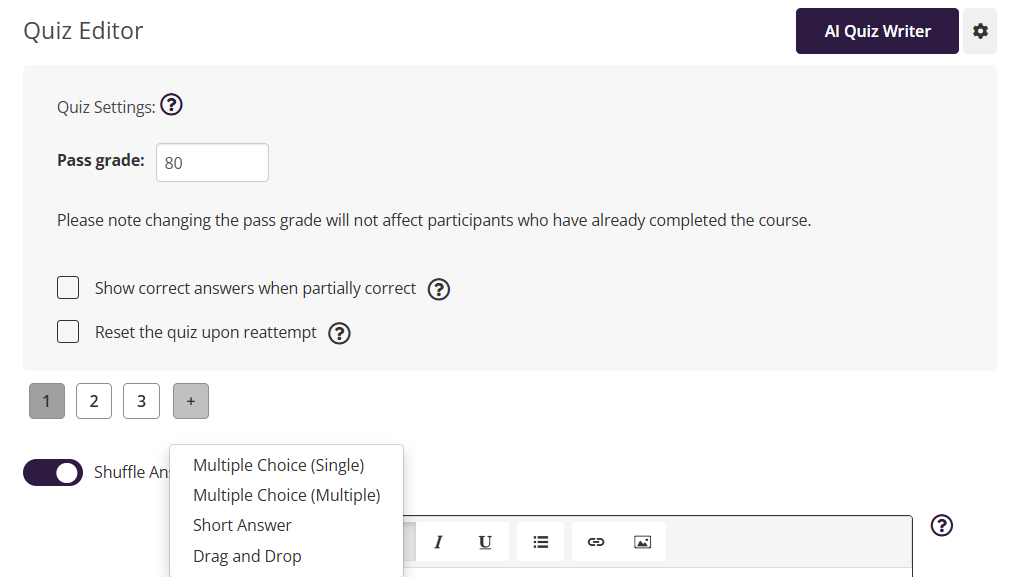
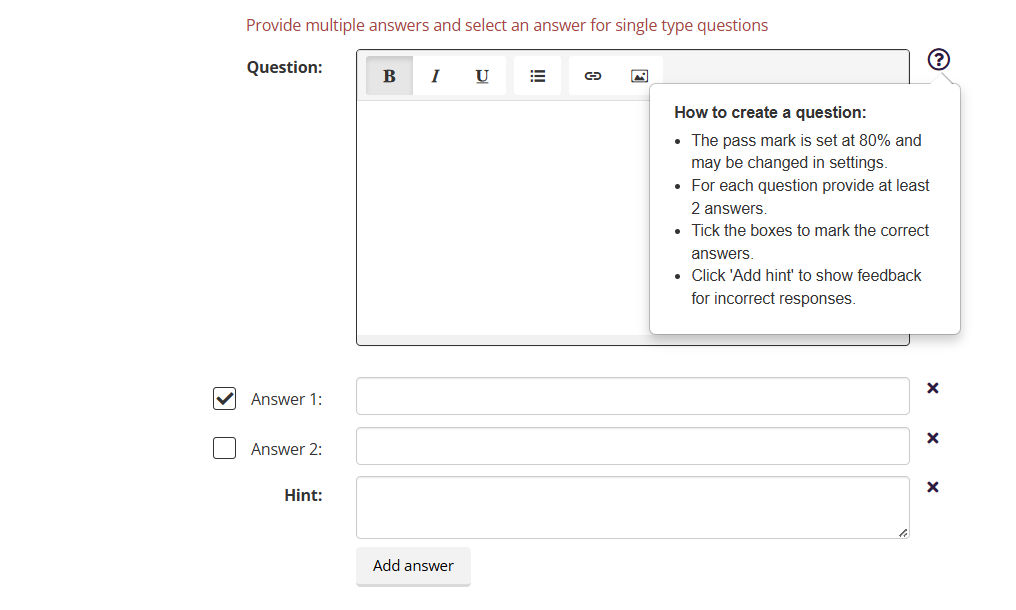
Multiple Choice (Single)
Learners select one correct answer from a list of options.
- Click + and select Multiple Choice (Single).
- Enter your question in the text box. Or use the AI Quiz Writer to generate questions based on your instructions.
Click Add answer and type in your answer options. Tick the checkbox next to the correct answer.
(Optional) Add a hint to guide learners if they struggle.
Save your question.
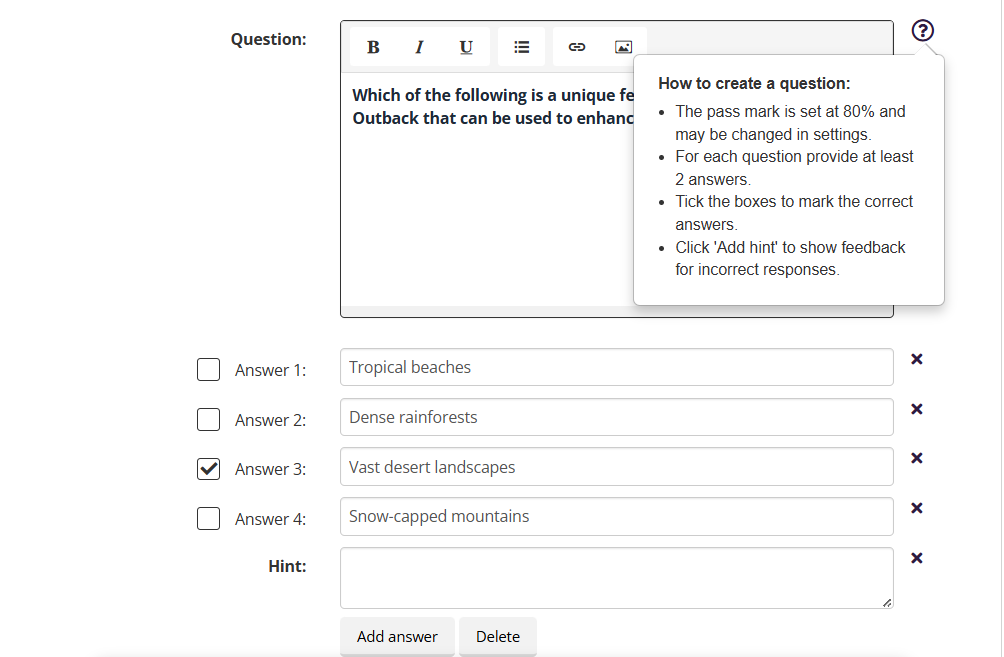
Multiple Choice (Multiple)
Learners can select more than one correct answer.
- Click + and select Multiple Choice (Multiple).
- Enter your question in the text box.
- Click Add answer to create several answer choices.
- Tick the checkboxes for all correct answers.
- (Optional) Add a hint to provide extra support.
- Save your question.
Short Answer
Learners type a written response that matches the correct answer(s) you provide.
- Click + and select Short Answer.
- Enter your question in the text box.
- Enter the correct answer(s) in the answer field. The AI evaluates learner responses based on the prompt and correct answers provided by the course admin in the answer field.
- (Optional) Add a hint to assist learners.
- Save your question.
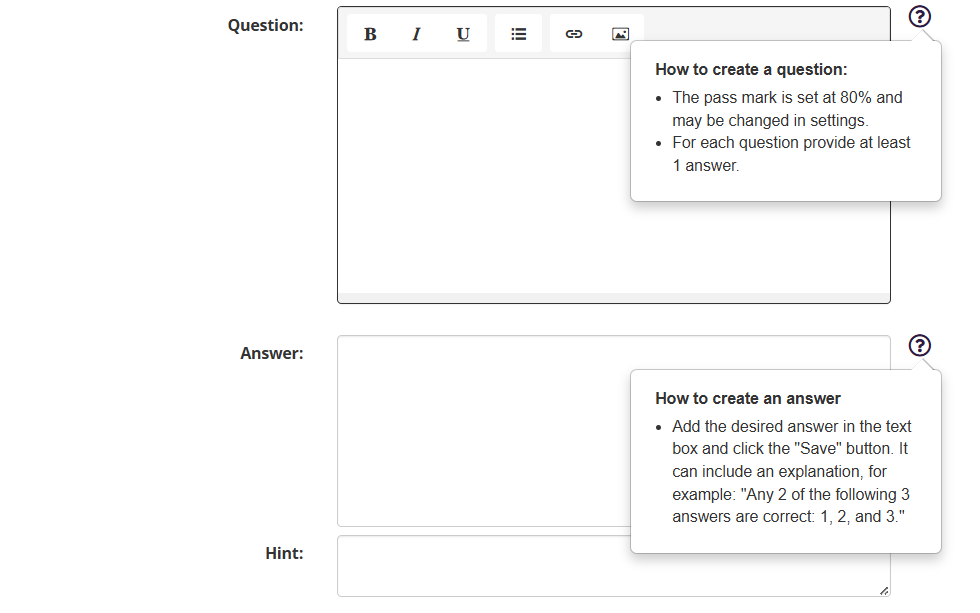
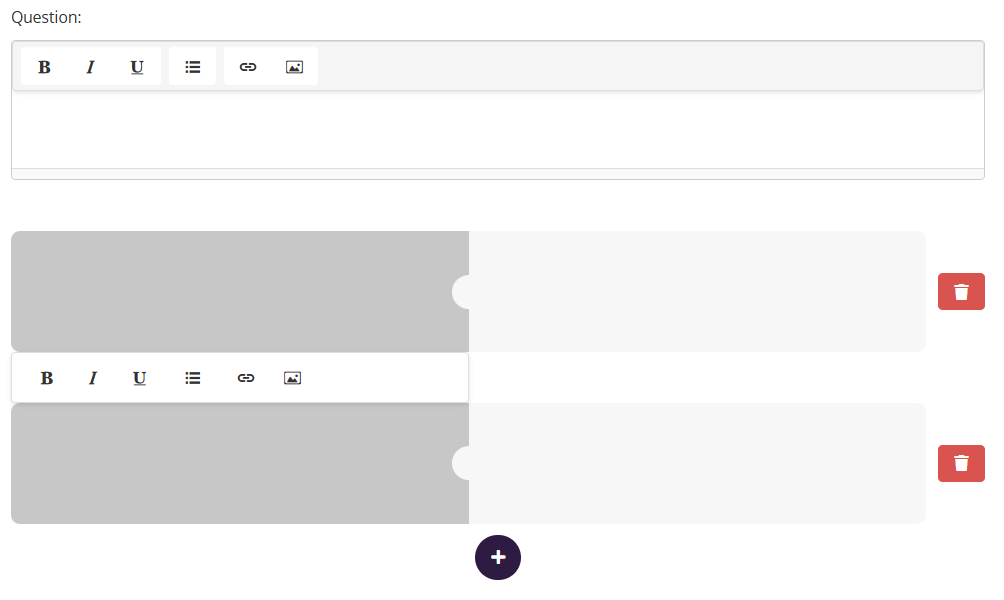
Drag and Drop
Learners drag items into the correct order or categories, making the quiz more interactive.
Click + and select Drag and Drop.
Enter your question in the text box (e.g., “Arrange the steps of the design process in order”).
Add the items learners will drag.
Define the correct order or drop targets.
(Optional) Add a hint to help learners.
Save your question.
Learner Response to a Quiz or Short Answer (Speak Mode)
Speak Mode is a standard feature in Coursebox and is automatically available in single/multiple choice and short answer quizzes.
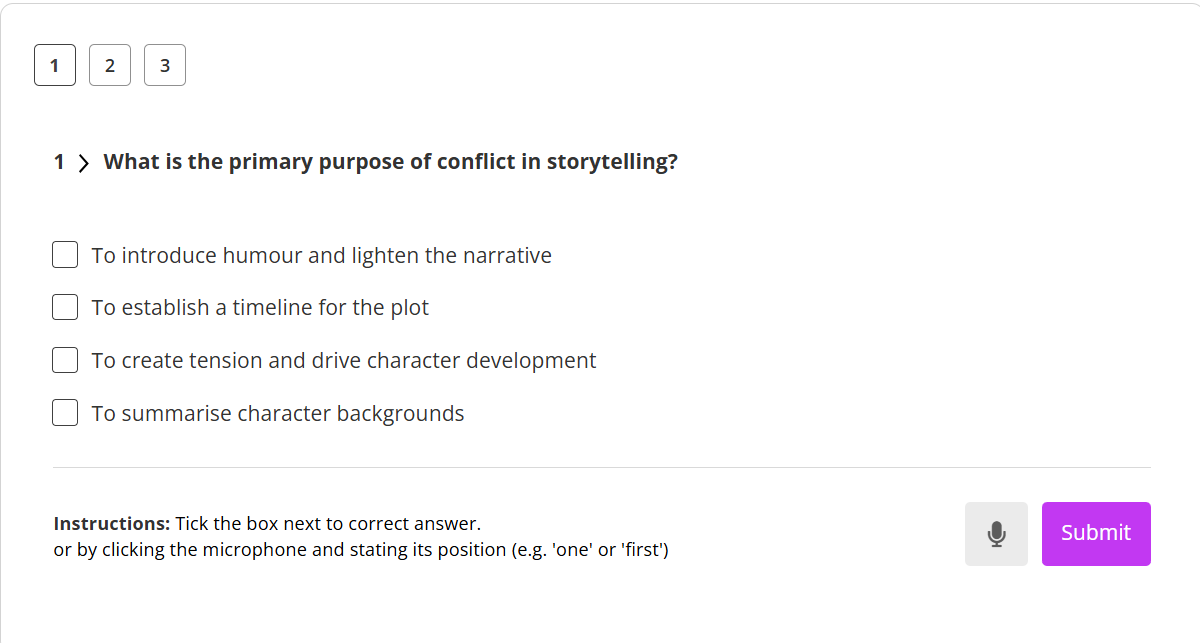
When a learner views a quiz question:
- The question is displayed on screen
- Answer options appear as selectable checkboxes
- A microphone icon is shown, allowing learners to respond using voice commands
- Coursebox listens for simple verbal responses (for example, “one”, “two”, or “third”) and automatically selects the corresponding answer
- Learners can still adjust their selection manually before submitting their response.
When a learner views a short answer question:
A microphone icon appears next to the Send button
Learners can click the microphone to record their response verbally
Spoken input is automatically converted into text
Learners can review and edit the transcribed text before submitting
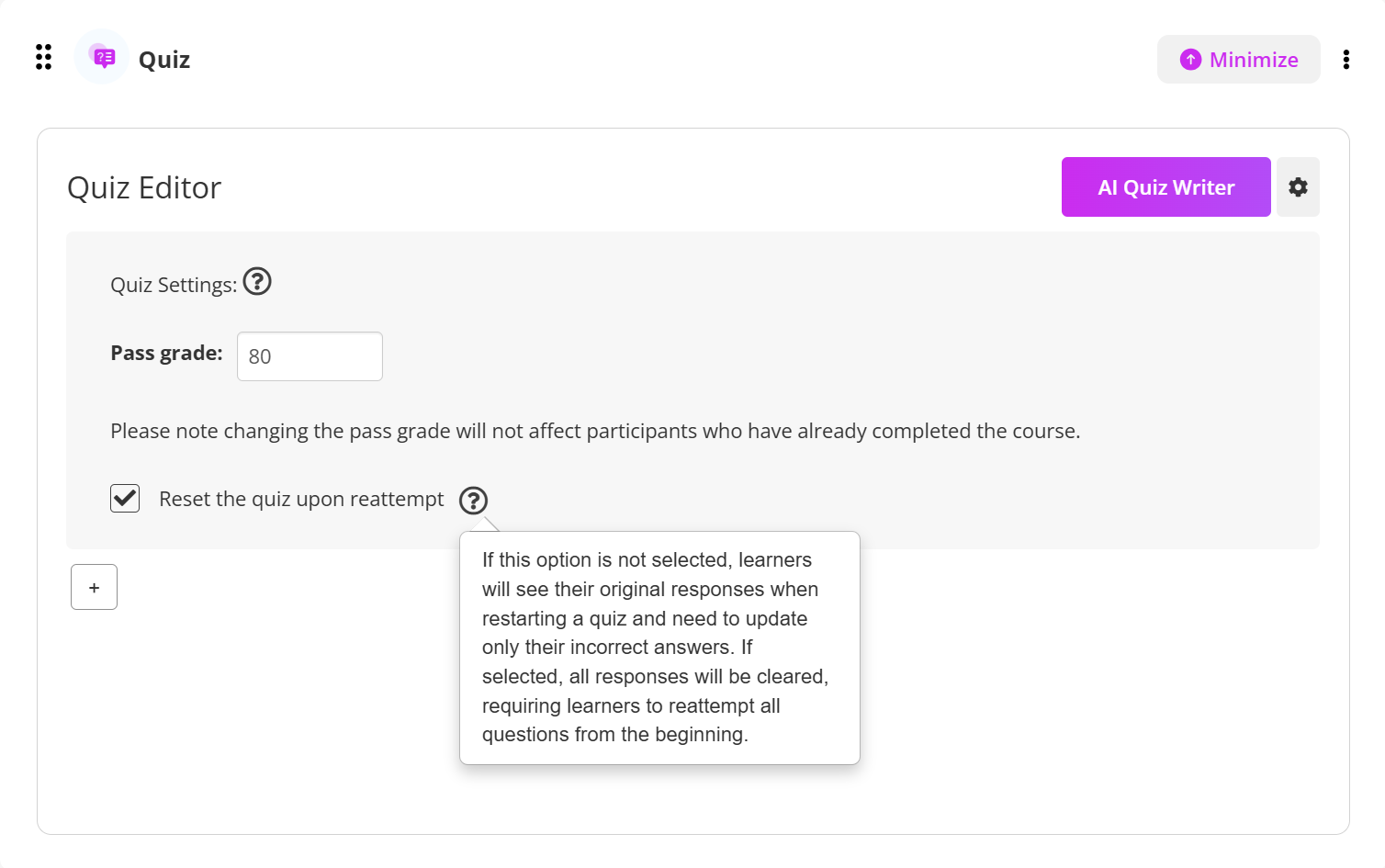
Reset Quiz Upon Reattempt
When setting up your quiz, you can choose whether learners will see their previous answers when reattempting the quiz.
- Unchecked (default):
Learners will see their original responses when restarting the quiz. They only need to update the answers they got wrong. - Checked:
All responses will be cleared, requiring learners to re-attempt every question from the beginning, regardless of which ones they answered correctly before.
Clickable Navigation for Incorrect Quiz Questions
Coursebox allows learners to quickly navigate back to incorrect quiz questions using the clickable question indicators displayed at the top of the quiz screen.
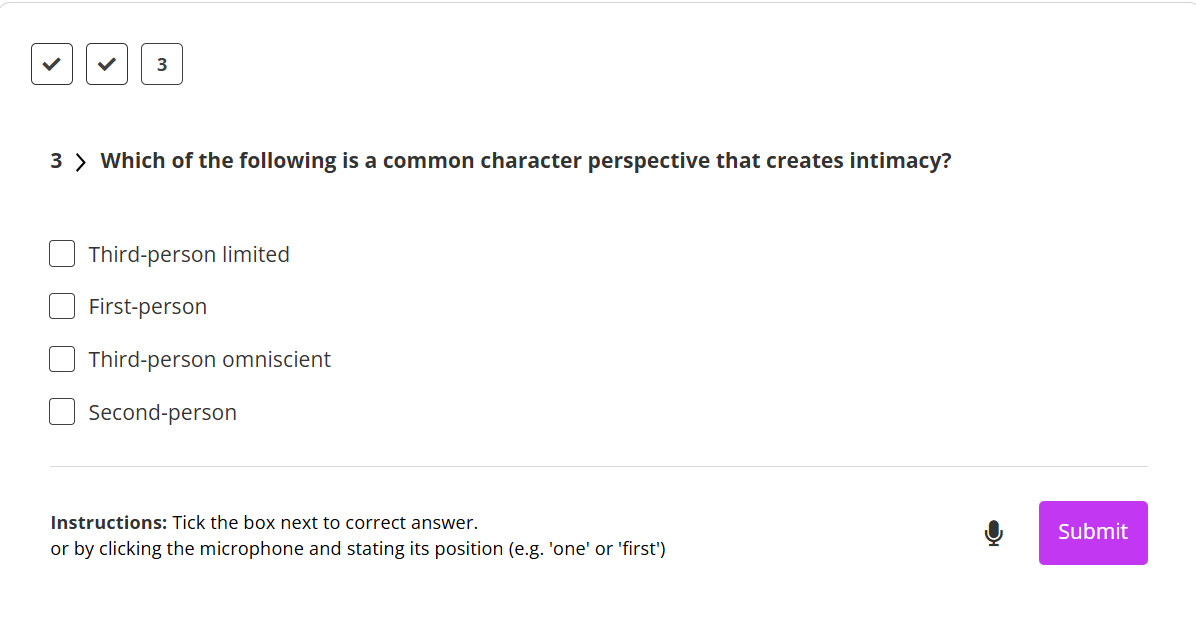
This feature helps learners review mistakes, improve understanding, and correct answers efficiently without manually scrolling through the quiz.
Adding Assignments
In Coursebox, you can add assignments to create checkpoints that require learners to complete a task before progressing to the next activity. This can include submitting written responses, recording a video, or leaving comments—each offering an opportunity for deeper engagement.
Create an Assignment Using AI Writer
The AI Assignment Writer helps you quickly generate clear, well-structured assignment instructions by entering a short prompt. You can use it to create scenario-based tasks, explore specific topics, or expand on existing content—saving time while maintaining quality.
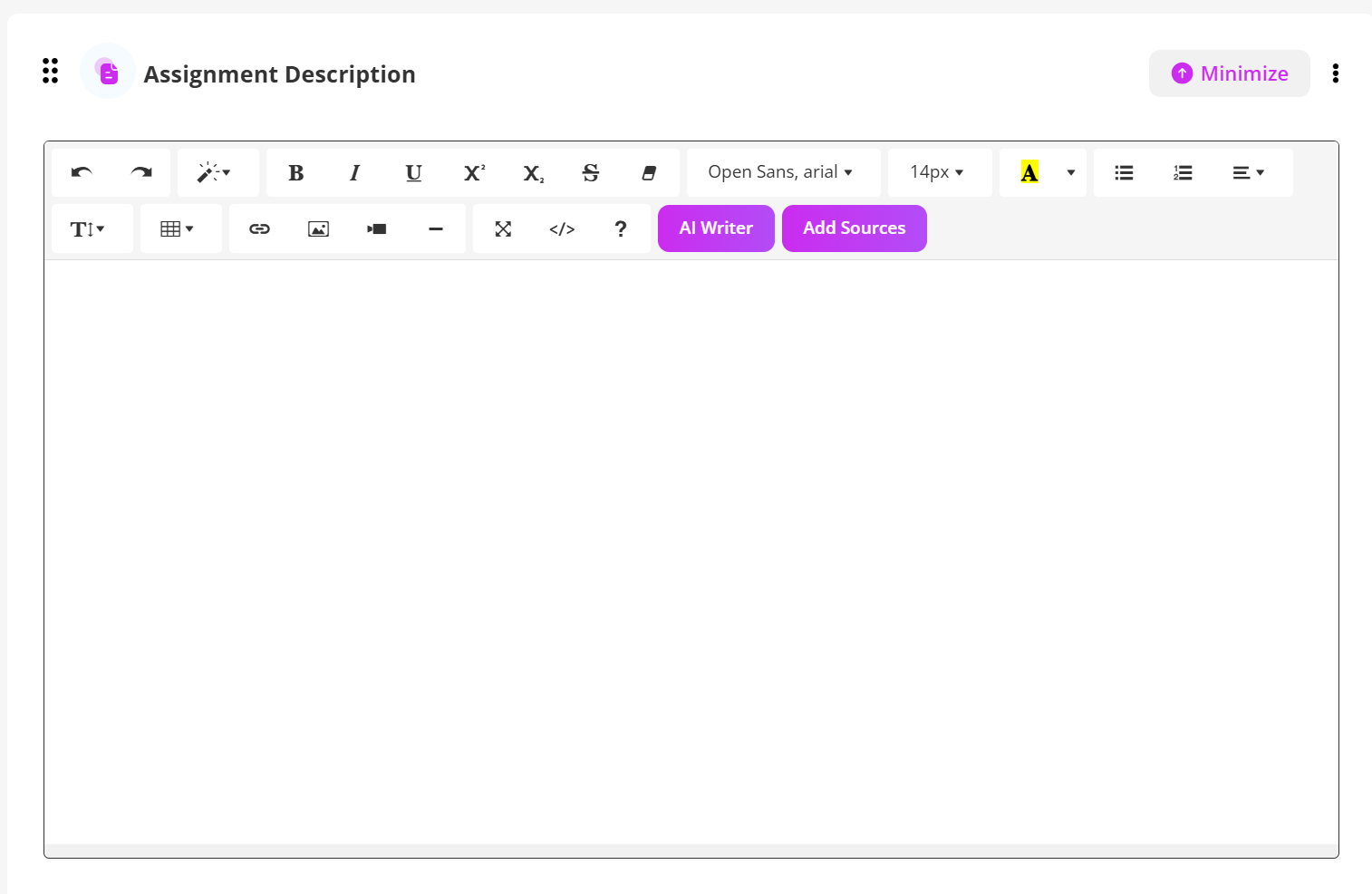
When the Assignment Description pop-up window opens, click AI Writer to launch the Write Text with AI panel.
In this panel, you can:
Choose whether to replace existing text or continue writing from what’s already on the page
Describe what you want the assignment to be about in the text field
Set the desired word count for the generated content
Click Update Page to insert the AI-generated text into your assignment
You can then review, edit, or refine the content before publishing the assignment.
Example: “Write a scenario-based assignment about Assignment 1 minimum 100 words.”
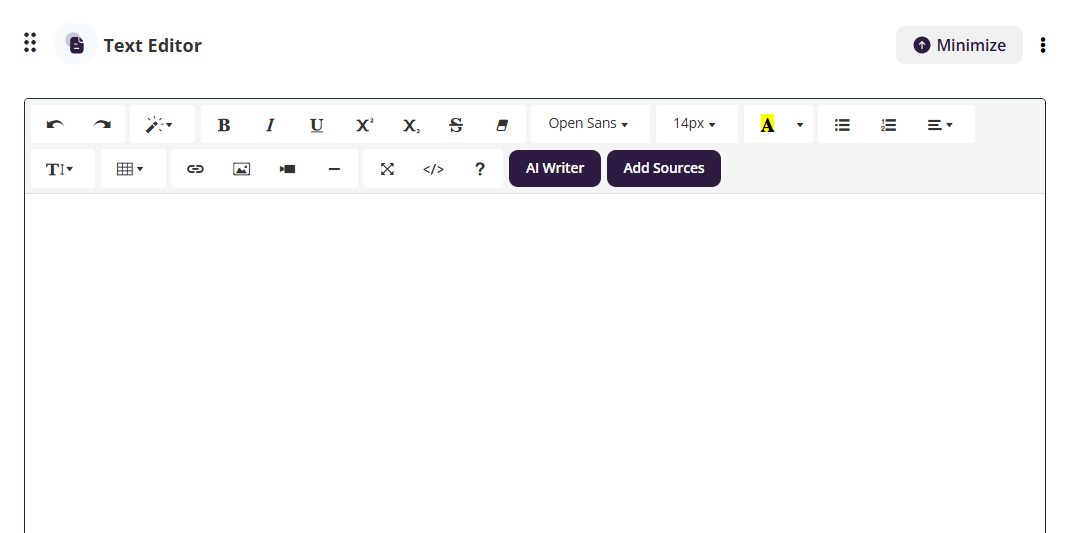
Note: When you create an assignment, a Text Editor section automatically appears at the top of the page. You can use this editor to enter your assignment instructions manually or generate them using the AI Writer.
Create an Assignment Manually
The steps are:
1. Click on Assessments and select Assignment from the bottom navigation
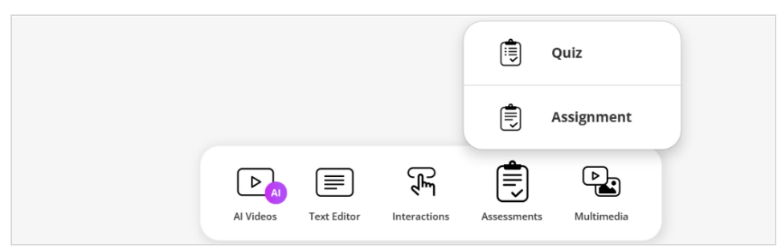
2. Add assessment description — write the assignment prompt, instructions, and relevant details.
Enter a description or prompt for the assignment. This is what learners will see, so include instructions, context, and any requirements. You can use the AI writer to help you with this section, steps below.
3. Choose assessment type from the dropdown menu then follow the steps below for each assessment type.
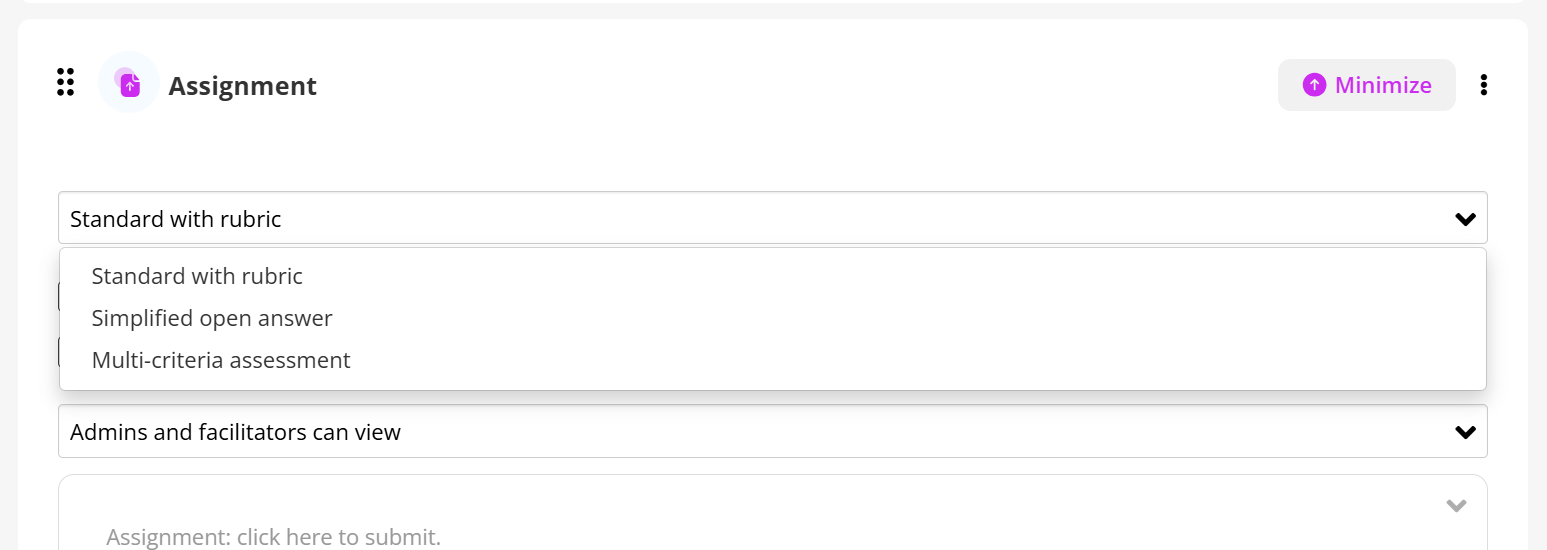
Note: When you create an assignment, a Text Editor section automatically appears at the top of the page. You can use this editor to enter your assignment instructions manually or generate them using the AI Writer.
Write an Assignment with AI (Video Submission)
Coursebox allows you to quickly create assignments with video submission using AI. In this example, learners are asked to record and submit a short video reflecting on their journey or experience.
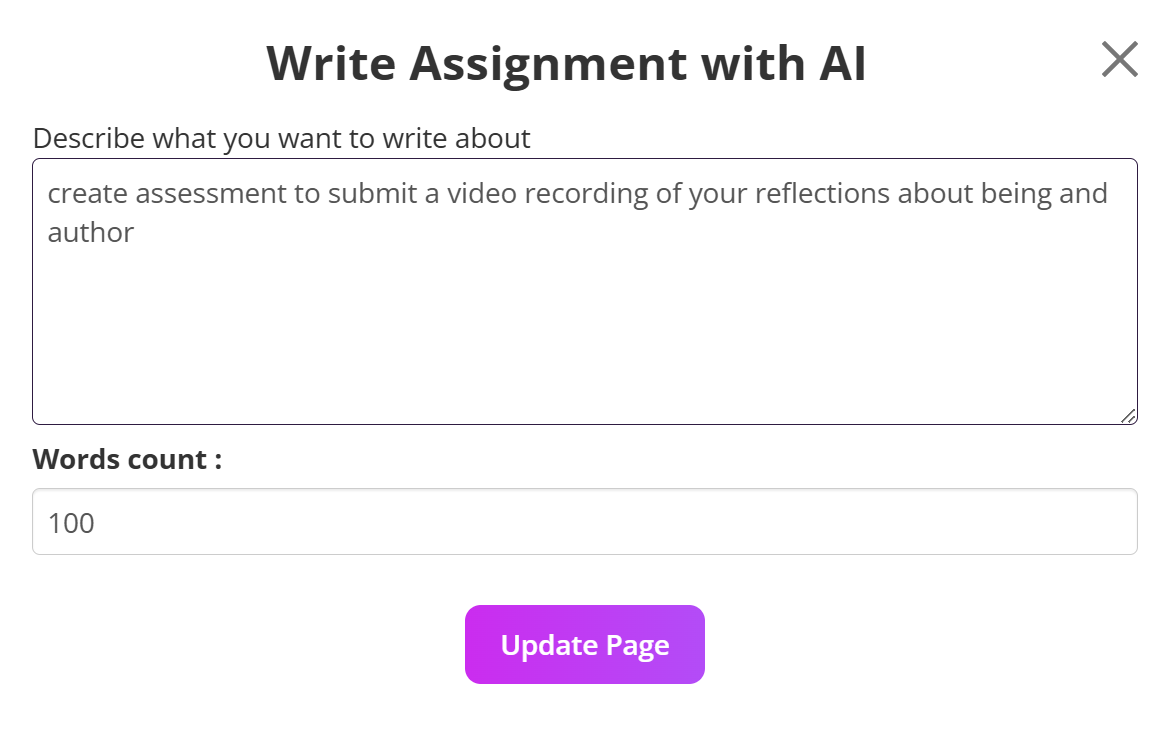
Create the assignment using AI
In the Write Assignment with AI window, describe what you want learners to do.
Example: Create an assignment where learners submit a video recording reflecting on what it means to be an author.
Set the word count (this guides the AI when generating the assignment instructions).
Click Update Page to generate the assignment content.
Configure assignment settings
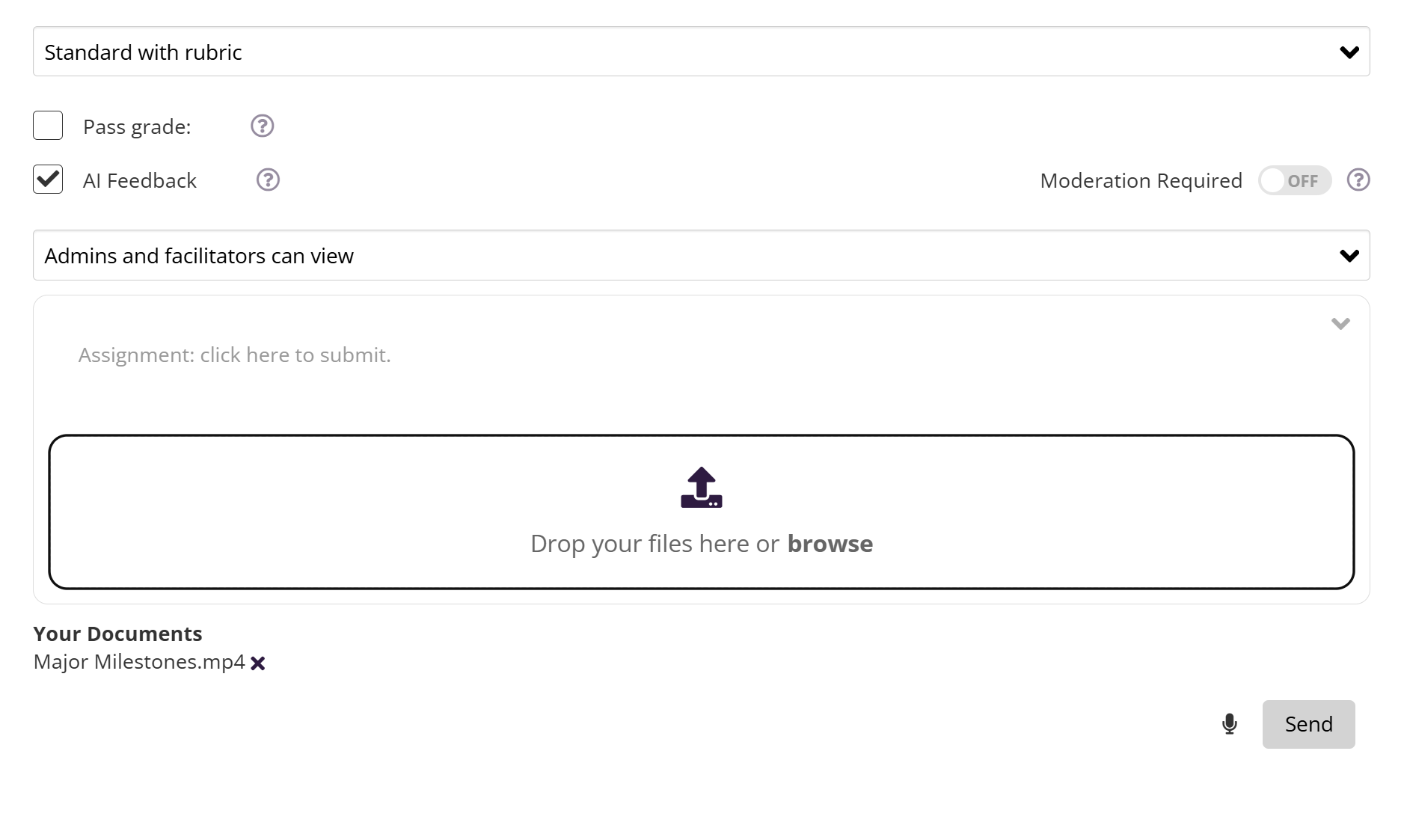
Once the assignment is created, you can adjust the following options:
Assessment type
Select Standard with rubric to assess submissions using clear criteria.Pass grade (optional)
Enable this if learners must achieve a minimum standard to pass.AI Feedback
When enabled, AI will automatically provide feedback on learner submissions.Moderation required
Leave off if submissions do not require approval before feedback is released.Visibility
Choose who can view submissions (for example, Admins and facilitators only).
Learner submission experience
Learners will see a clear submission area where they can:
Upload their video file by dragging and dropping it or selecting browse
Review uploaded files under Your Documents
Click Send to submit their assignment
Tip: This format works especially well for reflective learning, creative courses, coaching programs, and personal development content where video responses add depth and authenticity.
Use Standard with Rubric Assessment Type
This is the default. It allows you to set assessment criteria (a rubric) so submissions can be graded against set standards.
To create this assignment start with Steps 1 - 3 above, then:
- Choose assessment type
- From the dropdown menu, select Standard with Rubric (this is the default).
- Define the rubric
- Add your assessment criteria.
- For each criterion, provide a description and set performance levels (e.g. Excellent, Good, Needs Improvement).
- Assign points or weight to each level.
- Optional settings (See instructions below)
- Pass Grade: Enable and set a minimum required score for learners to pass.
- AI Feedback: Check this box to allow learners to receive AI-generated suggestions.
- Moderation: Turn this on if you want submissions to be reviewed before being accepted.
- Visibility: Choose who can view the assessment (learners, facilitators, or both).
- Save and publish
- Review your rubric setup.
- Save the assignment so it appears in your course sequence.
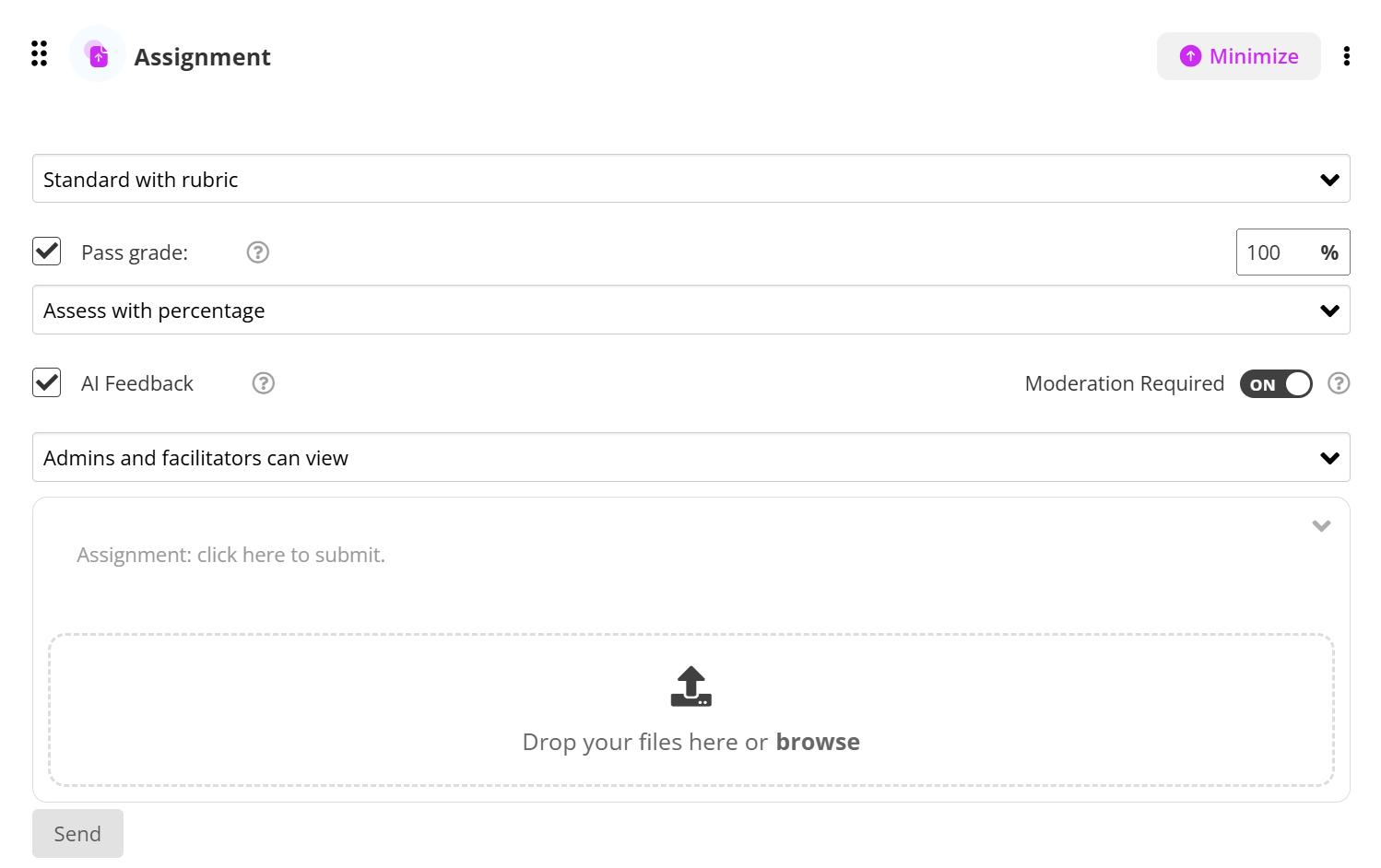
With Standard with Rubric, you ensure consistent and transparent grading, since learners can see the rubric criteria and know exactly how their work will be evaluated.
Select Simplified Open Answer Assessment Type
A more minimal format. Learners submit a free-form answer without a formal rubric. Useful for questions or reflections where detailed grading criteria are not needed.
To create this assignment start with Steps 1 - 3 above, then:
- Choose assessment type
- From the dropdown, select Simplified Open Answer.
- This type provides a single open-ended response box for learners.
- Configure response settings
- Set a word limit (optional) if you want to control response length.
- Decide whether learners can resubmit after initial submission.
- Optional settings (See instructions below)
- Pass Grade: Enable and set the minimum required score.
- AI Feedback: Turn on to give learners automated improvement tips.
- Moderation: Enable if submissions should be reviewed before being finalized.
- Visibility: Control who can see the responses (facilitators, peers, or both).
- Save and publish
- Review your setup.
- Save and publish the assignment so learners can access it in their course.
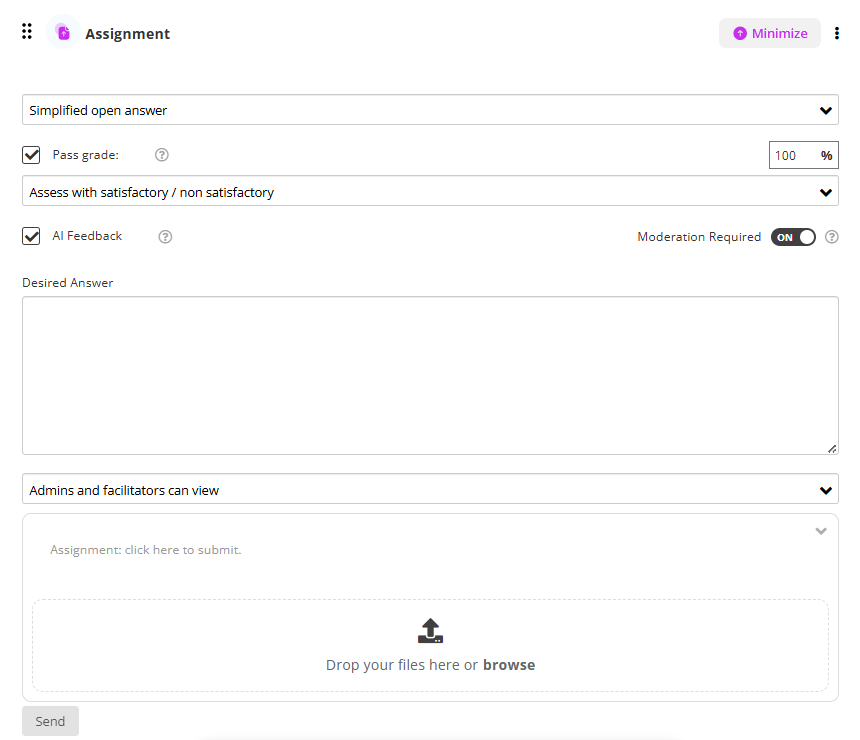
Simplified Open Answer is best for short-form responses, reflections, or questions where you don’t need a detailed rubric.
Select Multi-criteria Assessment Type
This option lets you create separate criteria for grading, so each submission can be evaluated across multiple dimensions (e.g. content, structure, style, accuracy).
To create this assignment start with Steps 1 - 3 above, then:
- Choose assessment type
- From the dropdown, select Multi-criteria Assessment.
- This type allows you to grade each submission across several defined criteria rather than giving a single overall score.
- Define your criteria
- Add multiple criteria (e.g. Content Accuracy, Structure, Style, Creativity).
- For each criterion, provide a clear description and, if needed, set a maximum score or weighting.
- Repeat until all desired criteria are added.
- Visibility
- Decide who can view the scores and feedback generated from the assessment — learners or admins and facilitators.
- Communicate expectations
- Share the criteria with learners in your instructions so they understand how their work will be assessed.
- Save and publish
- Review your setup, making sure each criterion is well defined.
- Save the assignment and publish it so it becomes available in the course.
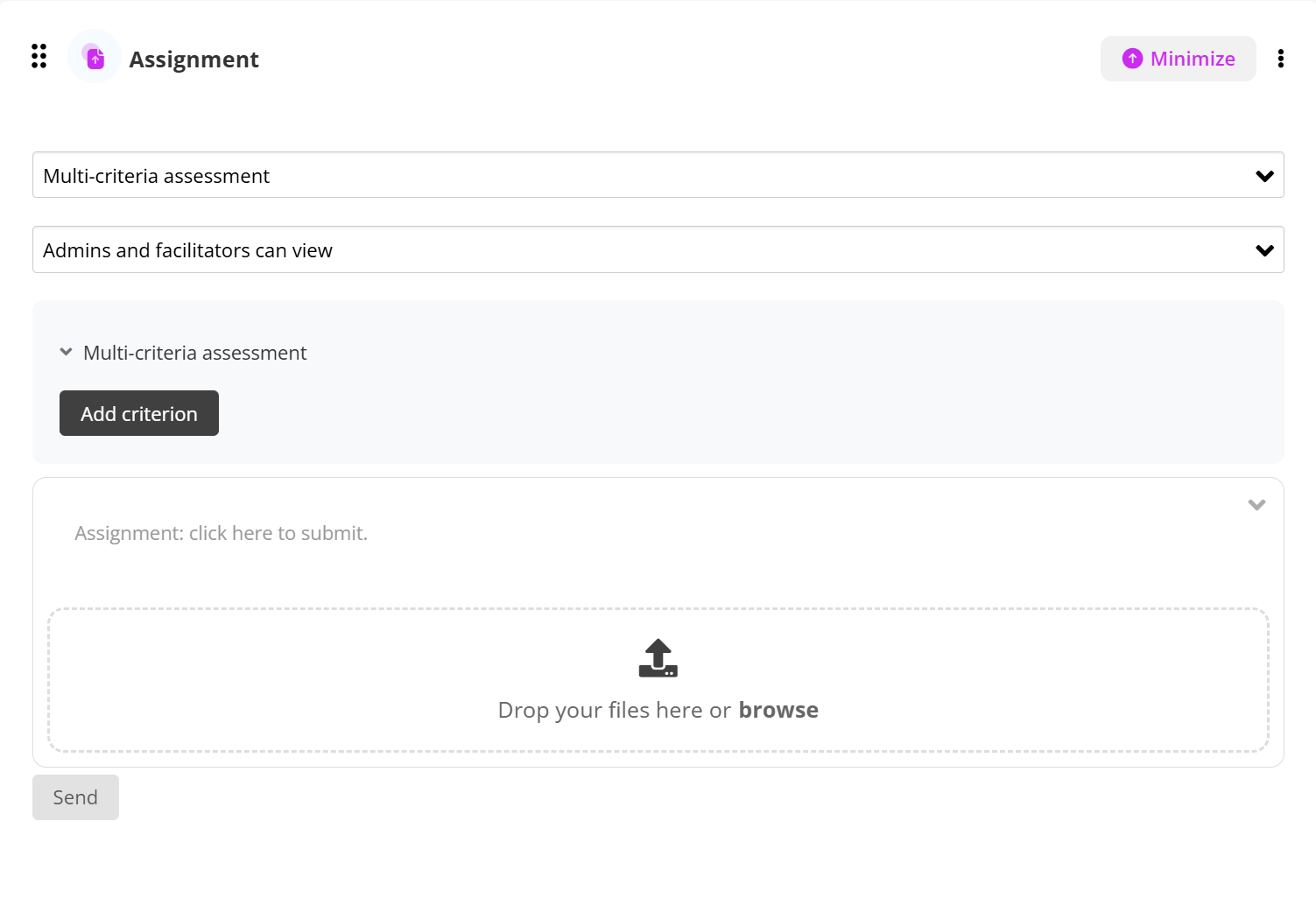
Multi-criteria Assessment is ideal when you want to provide structured, detailed feedback across several dimensions, giving learners a clear picture of their strengths and areas for improvement.
What does “Pass Grade” mean?
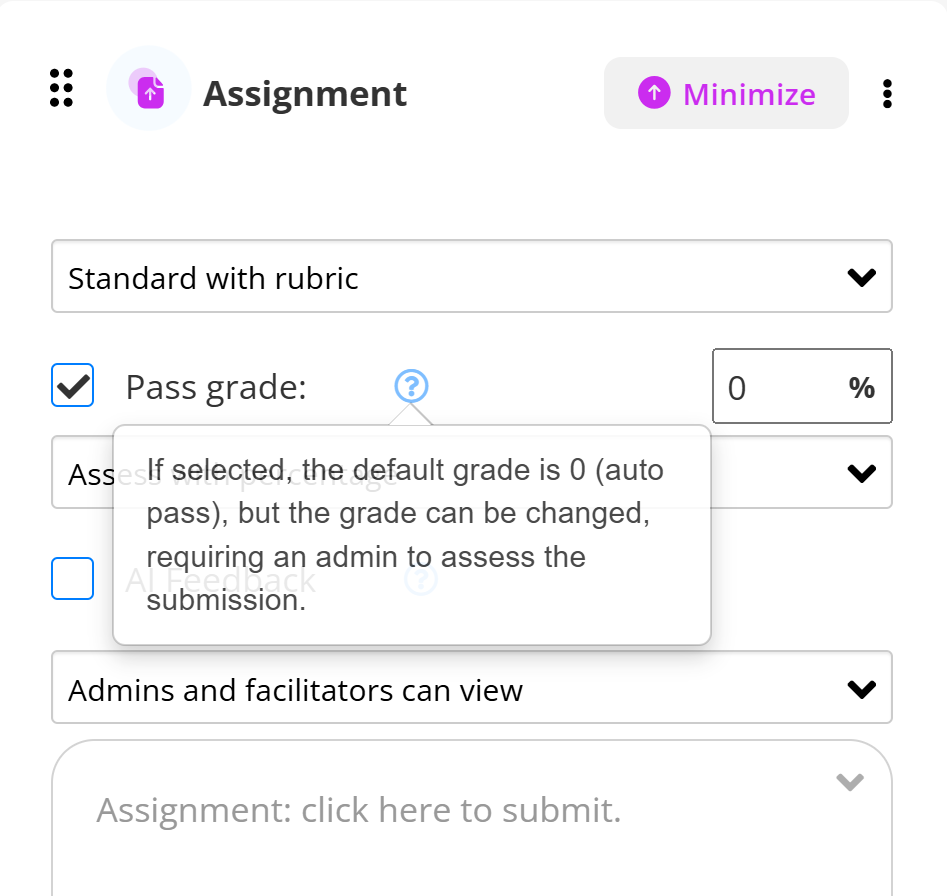
Some assignments have a minimum score learner's need to achieve. The assignment work will be checked by a facilitator or course admin, and once the learner reaches the required score, they will receive a Pass Grade.
To enable the Pass Grade option:
- In the assignment locate the Pass Grade field.
- Turn on the option to require a minimum passing score.
- Enter the score learners must achieve in order to pass.
- Use a numeric value that matches your course grading scale.
What does “AI Feedback” mean?
On some assignments, leaners can see instant feedback generated by AI. This feedback gives learners suggestions and tips to help improve their work before or alongside the facilitator’s review.
To enable AI Feedback:
- In the assignment settings panel, locate the AI Feedback option.
- Tick the checkbox to activate automated, AI-generated feedback.
- This will provide learners with instant suggestions to help improve their submissions.

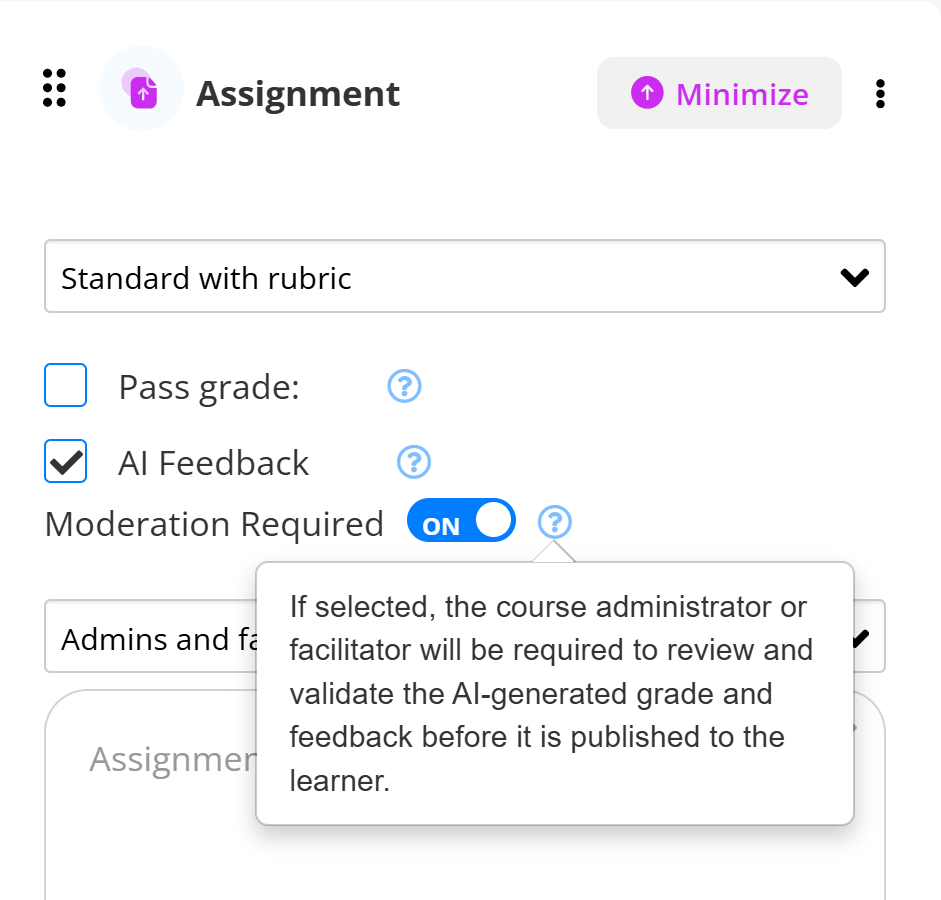
What does “Moderation” mean?
For some assignments, the learner's work will be reviewed by a facilitator. This ensures the learner's submission meets the required standards before it becomes part of their course record.
To enable Moderation:
- Open the assignment settings panel and locate the Moderation option.
- Toggle the option on to require facilitator review.
- With moderation enabled, learner submissions must be checked and approved before they are published or accepted.
What does “Visibility” mean?
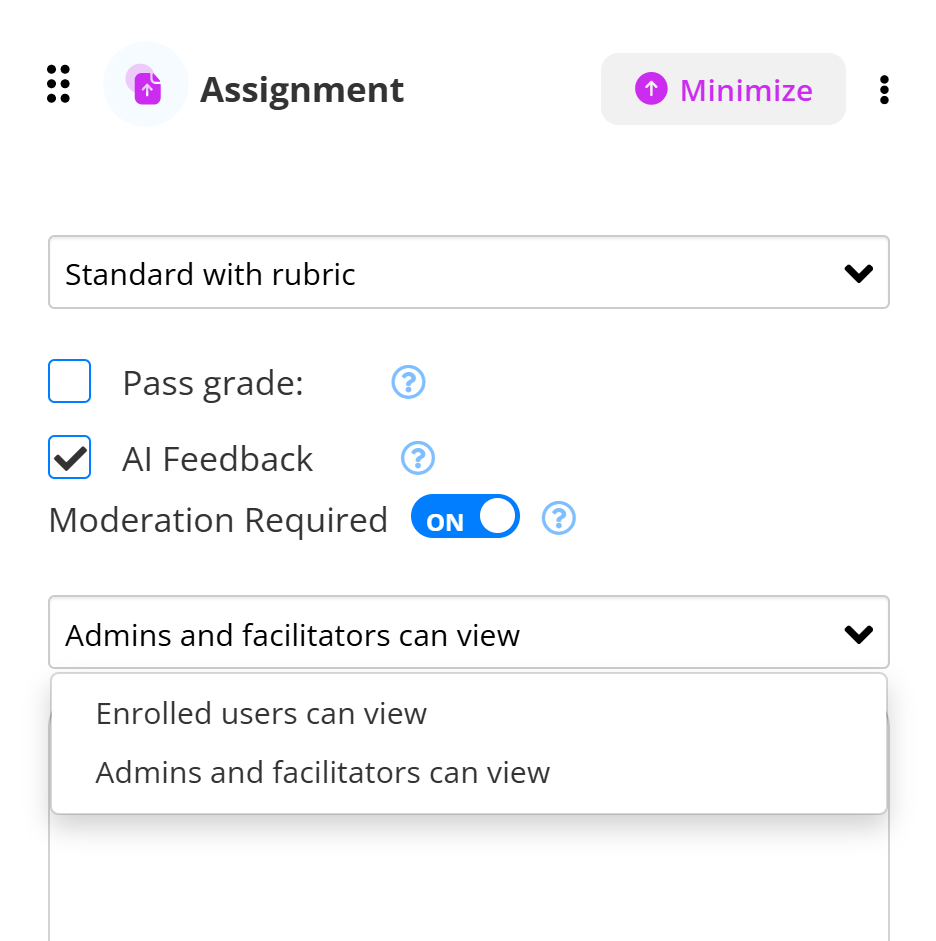
Visibility controls who can see learner scores and feedback. Depending on the setting, results may be shown only to facilitators and admins or to learners also.
To set Visibility:
- Open the assignment and locate the Visibility option.
- Use the dropdown menu to select who can view the assessment results (e.g. learners or facilitators and admins).
Learner Response to an Assignment (Listen & Speak Mode)
Coursebox assignments support multiple ways for learners to engage with and submit their work, including Listen Mode, Speak Mode, and file or text submission. This flexibility allows learners to choose the method that best suits their learning and communication style.
Listening to the Assignment Instructions (Listen Mode)
When an assignment is opened:
The assignment title and instructions are displayed on screen
An audio player appears at the top of the assignment
Learners can play, pause, or replay the audio to listen to the assignment instructions being read aloud
Listen Mode helps improve comprehension and accessibility, particularly for longer or scenario-based assignments.
Responding to an Assignment (Speak Mode)
Assignments can be completed using spoken input instead of typing.
When Speak Mode is available:
A microphone icon appears next to the Send button
Learners can click the microphone to record their response verbally
Spoken input is automatically converted into text
Learners can review and edit the transcribed text before submitting
This is especially useful for creative, reflective, or narrative-based assignments.
Watch the Tutorial Videos found in our Demonstration Video Library.
Was this article helpful?
That’s Great!
Thank you for your feedback
Sorry! We couldn't be helpful
Thank you for your feedback
Feedback sent
We appreciate your effort and will try to fix the article